Monday, November 18, 2013

Tarnishing the Brand

Yesterday was a run-through for Thanksgiving dinner, which means not everything had to be traditional. For example, I did not stuff the turkey, hoping to spend less time working on it on Sunday. Instead, my husband and I each made stuffing that we baked separately. That worked out just fine, but I doubt he'll go along with it for Thanksgiving itself.

Since I picked up a fresh turkey at Costco on Friday, I decided to try a dry rub instead of a brine and I used the mix I found in the February issue of Bon Appetit, with star anise, fennel seeds, fresh thyme, hot pepper flakes, brown sugar and kosher salt. The rub worked well and everyone enjoyed the turkey. Unfortunately, the rub proved too much for the Cuisinart Spice and Nut Grinder I bought from Sur La Table.

I'd wanted an actual spice grinder for some time. When the coffee grinder was one of the losses from the house fire, I had an excuse to buy one made for spices. I think I had a discount at Sur La Table after taking a class and they had the Cuisinart in stock, so I bought it. Unfortunately, I can't remember when exactly I bought it (certainly within the past two years, because it did not precede the purchase of the new house.) I did not actually use it until Saturday.

It ground to a complete and utter stop. I thought it might have just overheated, so I let it cool off. Dead as a door knob.

I am very disappointed. I suspect it is too late to return it. I no longer have the box, although I guarantee I've got the receipt somewhere in a box. I own a lot of products with the Cuisinart name--I still have my original food processor, purchased in 1978, and it works just fine. But this item did not live up to expectations.

Thursday, January 10, 2013

Roasted Radishes

Every year, I like to try a new dish at Thanksgiving to add to the standbys. Four or five years ago, I learned how to make a sweet potato souffle, which has been a huge success and beats the hell out of the sweet potatoes with marshmallows everyone seems to expect and then won't eat. This year, I gave roasted radishes a try. I'm still stunned by the approval ratings.

The dish was prompted by the many bunches of radishes that were arriving twice a month in my farm box. Like fresh tomatoes, I think I'm the only person in my house who will eat the fresh radishes, so they were piling up in the refrigerator. I stumbled upon a recipe on-line and realized it would be a quick fix during the busy prep that is Thanksgiving. It also turns out to give a lovely burst of color to the table and it could not be easier.


Remove the greenery and long root from three bunches of radishes and scrub the bulbs. Coat the radishes with a layer of olive oil and spread on a roasting pan. Generously sprinkle with kosher salt and fresh herbs (thyme and rosemary are good choices.) Stick the pan in an available space in the oven (I think I used a temperature of 375F, but I've seen 425F suggested.) Cook for 30-40 minutes, stirring as you have time, until tender but not mushy.

As I said, very easy. And very good.

Wednesday, December 19, 2012

NY Times Gets It Wrong

I just read a puzzling article in the New York Times. I haven't read all of the comments, but I did note that some people reacted the same way I did. They found the writer arrogant and annoying.

The writer is describing the differences in the way her parents eat versus the way she and her siblings eat. That's fine. I get that there can be differences. I remember the first time I took my mother to an Ethiopian restaurant close to 35 years ago. She liked the food--she's always been an adventurous eater, as was my father, and so were all of us kids--but she couldn't deal with the community platter and eating with her hands. It made me giggle.

What had me metaphorically hitting the roof was her assertion that her "baby boomer parents" served slop and glop starch, just like their frugal parents had done in the depression. Whoa!

I'm a baby boomer. I sure didn't eat that way as an adult. My parents were children during the depression, but that's not the way they ate either, and it sure as hell wasn't the way my grandparents ate. Just because your parents had no skills in the kitchen is not a reason to make ignorant sweeping generalities about other people of their age. It just shows that you don't know what you are talking about. Hence, an arrogant and annoying writer.

I grew up in an Italian-American family, with a little Czech thrown in on my father's side. My grandparents kept gardens and used wild foods like greens in their cooking. My Czech grandmother could stretch a strudel dough by hand. My Italian great-grandmother made wine in the unheated back room of the house. My father hunted and fished, and there was often venison on the table in the winter, trout in the summer.

Food was a great celebration and a lot of the convenience foods of the 1950s were banned from our household. We never had frozen dinners. My father specifically refused to have Chef Boiardi canned goods in the larder. There was less objection to Campbell's soup, but mac and cheese was made from dried pasta, not Kraft, and tuna noodle casserole was regular home made fare on meatless Fridays. My mother baked, I learned to bake. I started pouring over her cookbooks by the time I was about 10, teaching myself how to make doughnuts and pizza. It was a time when there was still required Home Ec in junior high, and even then I couldn't understand why boys weren't required to take it as well.

Sunday meals were filled with extended family and always included a pasta dish in addition to a main course. Often my grandmother would make the pasta by hand. As I have written elsewhere, the smell of flour and eggs always accompanies my thoughts of her. She died in 1962, and my mother still complains that her own stuffing or tomato sauce does not taste like her mother's.

Eating out was a challenge because options were limited to us near home. I came from a truly small town of about 4,000 people. There was a coffee shop for breakfast after church on Sundays (we collected the little containers that had jam to use as doll dishes), there was a "nicer" restaurant for special occassions, but the nearest pizza place was 30 miles away until after I went to college. I am now under the impression that having a pizza place nearby was pretty unusual until the 1960s, but that was not my experience. If my parents really wanted to celebrate, we'd go to Binghamton and eat at the Little Venice, which, contrary to its name, actually served southern Italian food. Back in the 1950s and 1960s, no one knew what northern Italian food was.

My parents had met through mutual friends who were Greek-Americana, which introduced us to a different kind of ethnic cooking at an early age. I first learned how to make Greek food to impress a college beau, and it remains one of my favorite cuisines, along with its close relations in middle-eastern foods.

When I went to college on Long Island, and then, like the writer of the article, moved to New York City after college, the vast array of world cuisines was suddenly available to me. As an editorial assistant, my lunch generally alternated between the $1.50 lunch specials at Shalimar (Indian) and Cedars of Lebanon, each around different corners of my office. There was a Spanish (not Mexican) restaurant a few block from my apartment where I once saw Norman Mailer having dinner. Ararat was a special-occasion Turkish place, memorable for its sweet, thick coffee. I had my first experience with sushi and shabu-shabu because a photographer friend loved all things Japanese (I now have a son with the same obsession.) As everybody should, I have a story about the Russian Tea Room. New York has perhaps the greatest variety of food in the world (even when I lived there), which is probably far different from San Antonio of the Times writer's childhood. (It's been about 15 years since I visited San Antonio, and I had some terrific meals along the waterway.)

I too lived briefly in the San Francisco area, and there's still not pizza that compares with what you can get on any street in New York. But I was blown away by the Chinese restaurants, not limited to the Cantonese fare of the New York of my youth. I first had potstickers and hot and sour soup at a cooking demonstration at the Lou Henry Hoover House at Stanford. I was taken to Sam Woo's and entertained by the legendary Edsel Ford Fong and had noodles I've never found anywhere else.

So, Amy Chozick, as a friend of mine said, you are a food snob, and your premise, blaming the uninspired food of your childhood on your baby-boomer parents being raised by Depression-era survivors is wrong. Let me suggest a few other things: your grandmother, like my late ex-mother-in-law, was raised by someone from a white-bread culture who never learned to cook interesting food or was limited by the foods available in their area. I have found that many of my friends, whose families' time in this county greatly exceed the 100-125 that my families have been here, were raised on food that reflects that of your child hood. More recent immigrants are more likely to serve ethnic fare. Maybe your mother learned to cook in a Home Ec class, which had cookbooks provided by the gas or electric company and was heavy on the frozen or convenience foods of the 1950s and 1960s, or maybe, like a number of the well-educated, full-time working women I met when I lived in Washington, she just never learned.

What does the well-educated woman make for dinner? Reservations. Perhaps that wasn't practical for your mother, with a growing family in a pre-foodie-culture city. I raised my son, whom I suspect is around the same age as Ms. Chozick, to be an adventurous eater. He grew up eating sushi, Chinese, Indian, Turkish, Greek, Lebanese, Mexican and Italian foods. That was easily accomplished in the Washington, D.C. suburbs of the 1980s.

I cannot tell you how many women I've known who were amazed that I did all of my dinner party cooking myself. I still meet contemporaries who marvel that I enjoy cooking. There is a crowd of people at my dinner table most Sunday nights who love the way this baby boomer cooks. So the problem, Ms. Chozick, isn't the baby boomers. I suggest you eat a little crow for your next meal and be nicer to your parents.

Monday, August 27, 2012

Separation Anxiety

My son gets very nervous when he has to separate eggs. I was taught to use the two halves of the shell method. The link shows you what is, without a doubt, the simplest, most tidy way I have ever seen to separate an egg. I recommend that you just open a fresh bottle of water and empty it out before you try to do this. I'm not sure I'd trust how clean the bottle would be after drinking from it, no matter how hard you scrub. Using a plastic bottle to separate an egg.

I'm almost tempted to bake an angel food cake, just to give it try. There is little as much fun as applying science to your baking (creating a vacuum is what sucks in the yolk, if you weren't aware.)

Monday, August 6, 2012

Duplex on Third

Len had to go to Cedars for some tests today, so I decided we'd take advantage of our location to try lunch at Duplex on Third Street, directly across from the hospital complex. We were not disappointed.
The restaurant has been open just about a month, and my friend Vanessa DiSteffano is the pastry chef. Our waiter let her know we were seated out on the veranda and she soon popped on by to say hello. She looked and sounded very happy.
Seviche at Duplex on Third.
We asked for menu recommendations and she said the seviche was very popular. I decided to give it a try along with the gazpacho to make a meal. Len decided to try the roast beef sandwich after Vanessa said they cooked everything in house.

Vanessa sent over two desserts from her menu for us to try: brioche beignets with a Valhrona  chocolate center and a panna cotta with apricots. If I can figure out how to import them, they eventually will show up here. Both were delicious. I'm looking forward to trying the crab cakes the next time I visit.

Getting the pictures that I took on my iPod over to this blog has been a challenge. I could get them to upload to Facebook, but not to Blogger. If anyone has a clue why this would be so,  please let me know.

Thursday, July 26, 2012

A Return to Sur la Table, Part 2

As it came up on June, I realized that I had a personal leave day that I hadn't used and I would lose if I didn't take it before the end of the month. I tried to take it when my friend Melinda was in town, but her plans changed and I didn't want to waste it by hanging around my house. Not that I don't have plenty to do around my house, but I wanted to really enjoy the day. So, when I saw a class called "Celebrating Julia Child" that Vanessa DiSteffano was teaching on a Friday at Sur la Table, I thought it would be an excellent way to spend part of the day. Even better, I called my friend Susan Ellison who loved the idea of going with me.

This year marks the 100th anniversary of Julia's birth. Like many people, I remember her early shows on public television and the skewering she got from Dan Aykroyd on Saturday Night Live. Merle Streep got her distinctive voice down pat for Julie & Julia a few years ago. While classic French technique was not part of my culinary self-training, that movie did inspire me to give it a try when Bon Appetit did an August article about Julia and the movie, with some of her classic recipes. I bought a copy of Julia's famous tome, Mastering the Art of French Cooking, when I started rebuilding my cookbook collection after our fire. (I find it somewhat intimidating, but incredibly informative.)

My first step in learning classic French technique was to take two knife skills classes at Sur la Table (I sent my husband and son to one as well, and Michael has great knife skills because of it.) I don't do a lot of French cooking and we don't eat at many French restaurants, but I have to admit I'm always impressed by the food.

The menu for "Celebrating Julia Child" was Bouillabaisse with Clams, Mussels and Fresh Salt-Water Fish; Puff Pastry Tart of Heirloom Tomatoes, Eggplant, Caramelized Leeks and Gruyere Cheese; Cognac Flamed Breast of Duckling a l'Orange; and Grand Marnier Soufflé. Vanessa arranged the class so that we all got to work on each dish on the menu. (This is not always the case at Sur la Table. Depending on the menu, participants may only work on one or two of the dishes.)
Susan Ellison with our two team mates for "Celebrating Julia Child."
Our working group consisted of Susan and me and a pair of good friends who were spending the day together for fun like we were.  Susan is British and is a lot more competent in the kitchen than she sometimes lets on, but I think she favors baking over cooking, much as my son does.
Bouillabaisse simmering in the pot.
Bouillabaisse ready to be eaten.
 The bouillabaisse came together so quickly, I forgot to take photographs of the stew in process. Basically, the aromatics were chopped and cooked, liquid was added, the fish was cleaned and added, and a few minutes later, we ate.
Mise en place for the vegetable tart.
 The vegetable tart was a lot more steps. The puff pastry shell needed to be blind baked. 
Prepping the thawed puff pastry.
Blind-baked puff pastry cooling.
The vegetables and cheese needed preparation.
Sauteed leeks.
Cooking the eggplant with the leeks.
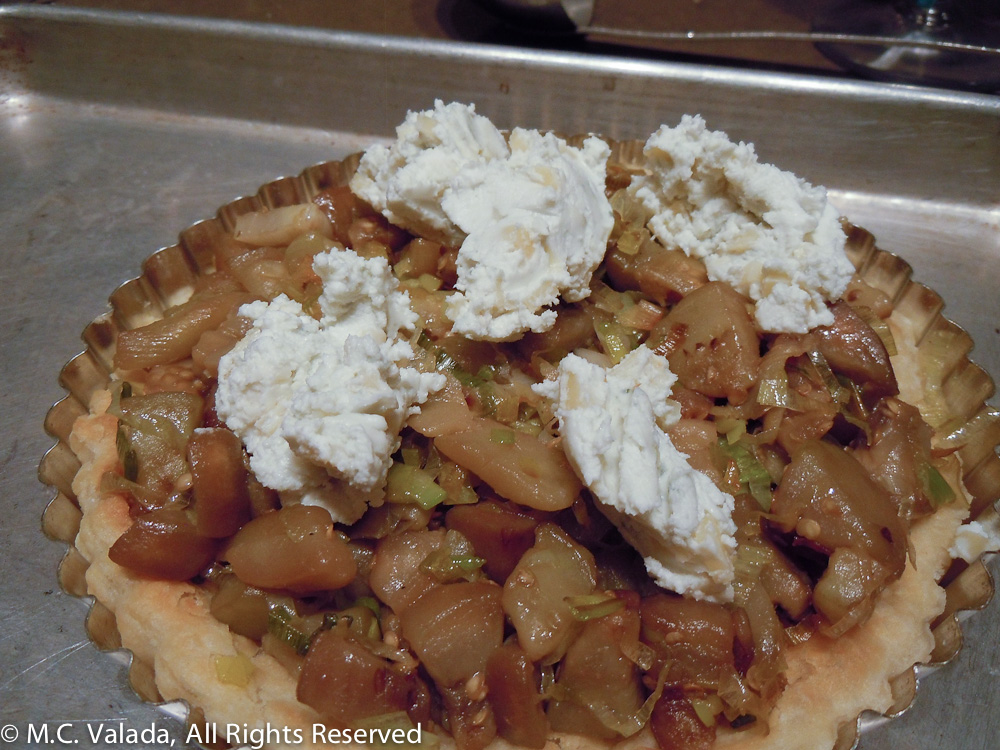
Filling the tart.

A layer of goat cheese.

The tomato layer.
Adding sardines prior to baking.
The garnish needed a special cut.
A chiffonade of fresh basil to be added to the finished tart.
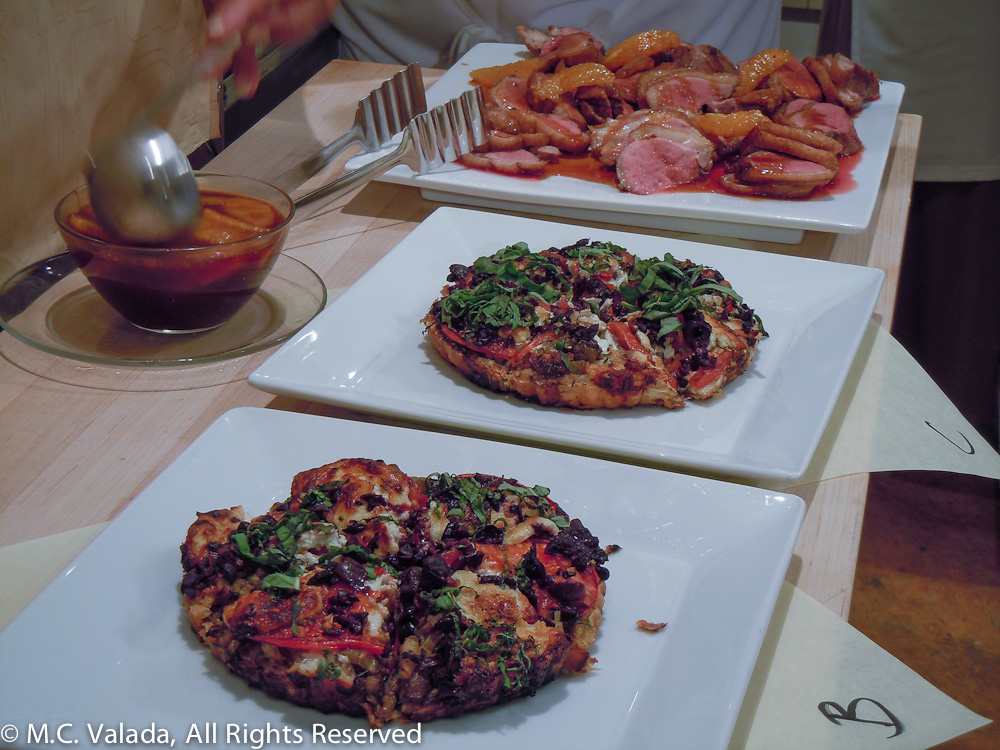
The finished tart.
All done!
And then it was on to the duck breast. I love duck. I felt very lucky to have it for two of the memorable meals I ate in Chicago earlier this year when I went to see my sister. Since it is not something Len likes, I'm unlikely to make it at home. It was much less intimidating learning how to do it at the class. And rendered duck fat is like making gold.
Prepared duck breasts, fat side down to start.
When they easily release, flip them once. Look at all that lovely fat. Think of sauteed potatoes.
The duck breasts were sliced and combined on one platter.
Vanessa prepares the sauce for the duck breast.
Flambeing the sauce.
Finishing the duck.
The other potentially intimidating aspect of this menu is the souffle. My big souffle production is usually limited to the sweet potato souffle I make for Thanksgiving, which isn't that hard and I don't give too much thought to it falling. The Grand Marnier Souffle was actually quite easy. My usual concern is the incorporation of everything without deflating the lovely egg-whites, but we definitely got through it.
Souffle batter.
Filling the baking ramekins.
Dessert.
This is one of the classes that ran late, because, of course, you must eat your results before leaving. We used to be able to take left-overs home, but the City started making noise and the company became concerned about food safety if students didn't properly store the food properly in transit. So we had a very nice lunch.
Our buffet.
Sur la Table is offering several other Celebrating Julia cooking classes over the next few months (it is actually a recurring theme) with different menus. Check out their on-line cooking class listings to find one near you. Taking a class at my local Sur la Table also means that I get a discount coupon which can be used for a week when shopping in the store. In California, it usually just covers our sales tax, but I'm happy to have it. I picked up a couple of nice goodies for my kitchen, including a 2 gallon drink dispenser with a blue-glass lid and some more pieces of Le Creuset which were already on sale (adding to my savings.)

Michael wants to take a class with me that focuses on preserving. He particularly wants to learn how to make jams and jellies. There's a class coming up at the end of next month which should be perfect, but I'm waiting to see what's available when the September and October schedules are posted to see what kind of seasonal fruit they'll be doing. That way, we might be able to start working on Christmas baskets. Bon appetit!

A Return to Sur la Table, Part 1

Thanks to my friend Vanessa diSteffano, who has been a teacher at Sur la Table for a number of years, I've enjoyed quite a few classes at the Farmer's Market location in Los Angeles. Sadly, Vanessa left the store to return to her work as a pastry chef at a newly-opened restaurant called Duplex on Third, near Cedars-Sinai. Before she left, I managed to catch two of her classes in June.

The first class was a lesson in making ricotta, mozzarella, and burrata cheeses.  I could not believe how easy it was to make fresh ricotta and I can't believe that it has taken me this long to learn. It is simply a matter of cleaning your tools thoroughly, heating some milk, adding salt and buttermilk, stirring and straining. Voila! Ricotta.

Fresh ricotta forming curds.
Drained ricotta. Just add a little cream.
Mozzarella is a bit more complicated, because it involves rennet, curd cutting, and stretching with reheating.
The mozzarella cooks while the ricotta cools.

Draining cooked mozzarella curds.

Mozzarella curds before shaping.
Vanessa salts the cooking curds.
Mozzarella curds have been shaped into a block. The creamy ricotta rests before stuffing the kneaded and stretched mozzarella.
We made burrata by stretching the mozzarella and stuffing it with ricotta mixed with cream. The mozzarella balls needed to be reheated to remain pliable.
Vanessa carefully reheats the mozzarella, which has been shaped into balls.
Tying the stretched and stuffed mozzarella into a pouch.
Finished burrata: mozzarella stuffed with creamy ricotta.


We then prepared glazed apricots to serve with the burrata as a kind of crostini. It was fairly easy to do.      
Mise en place for the glazed apricots.
After the apricots were mixed with orange juice and vanilla, they were laid out on a pan.
The apricots were generously sprinkled with brown sugar.
A torch was used to brulee the apricots.
Yum!
The bruleed apricots on top of the burrata and toast was delicious. The creamy ricotta served with salted honey was even better.

The class easily fit into the two hour time-slot. It does seem a bit wasteful to use so much milk to make so much cheese, but the results are definitely worth it.

Vanessa recommended a book from the New England Cheesemaking Supply Company  called  Home Cheese Making by Ricki Carroll. You can buy a kit for basic cheesemaking from them, or from Amazon.com, or (if you are very lucky) from a local cheese supply shop. It happens that there is a home cheese/wine/beer making shop tucked away just off Ventura Boulevard in Woodland Hills where I was able to find the book, vegetarian rennet, and other supplies right after I took the class. The book contains instructions for making aged cheeses as well as fresh cheeses. Even though I have a wine cellar, which would be an excellent location for aging cheese, the worry about contamination is a bit much for me to deal with. But I have no doubt I'll try my hand at some more fresh cheese really soon.

Next up, I'll write about the other class I took, based on Julia Child's work.


Tuesday, June 26, 2012

Cooking Fish at Sur la Table

Our "adopted daughter" Sara has been very disappointed that I never got around to posting photographs of  the results of the essential fish recipe class we took at Sur la Table a few months ago. I confess, part of the problem is I can't find the recipes, so I'm not sure I'll get the names right on them.
First up is the crispy-skin salmon with edamame pesto. Unfortunately, the fish which was purchased for the class lacked skin, but it still tasted pretty good. When Sara decided to make it for the mother's day dinner at our house, Lisa told her there was no way she was going to get enough of it done to feed the 14 or 16 people in attendance in time for a reasonable dinner hour. I'm happy to report that they found a way to do it in the oven and Sara did a fine job on the pesto. My son Michael used the left-overs on pasta.
I think, though I'm m not entirely sure, this is roasted halibut with tomato jam and possibly a panko topping. It was delicious.
This is for sure grilled ahi tuna served with some sauteed vegetables. There may be an orange sauce, which means that neither Sara, my son, or our friend Lorien should eat it. It was good, but would need a new sauce for the Sunday Super Supper Squad.
This was a baked cod or sole dish with definite Mediterranean flavors of tomatoes, olives, and feta cheese.
And here we have a nice couple of views of the presentation before the class dived into dinner.
As you can see, Sara enjoyed herself.

Sur la Table at the Farmers' Market (adjacent to The Grove) on West Third Street in Los Angeles offers periodic classes on cooking fish, which is an excellent way to learn more about this healthy protein. I saw that there's an upcoming class which concentrates on grilling fish. My friend who has been running the cooking classes program for about a year is leaving to return to her career as a pastry chef at the beginning of July (sniff!) But there are a number of excellent instructors remaining, most of whom have graduated from culinary school and worked in restaurants. I would strongly suggest taking the essential knife skills class (offered often) for anyone who wants to improve their performance in the kitchen, as well as the more advanced class in knife skills (rarely offered) if you want to safe money in the meat department.

Most classes run $69-$79 and end with a good dinner (or dessert) to sample. It is especially fun to take a class with a friend or two. Most classes are hands-on, and I guarantee you will learn something new every time. Plus, there will be a nice discount card to use for a week after the class.


Wednesday, June 20, 2012

Edible Superheroes

My husband had a birthday last week and we celebrated with some of our Sunday Super Supper Squad on, well, Sunday. My husband Len Wein created Wolverine (and Storm, Colossus, and Nightrcrawler), so buying the cake pan that Williams Sonoma sells was a no-brainer. (If Len had created Wolverine for DC Comics, there would have been no need to buy the merchandise because it would have arrived in the mail, along with royalty checks, but that's another story for a different blog.)

We've been using the six-character cakelet pan for wall decoration, since so much of the rest of the house is all about superheroes. On Sunday, my son Michael baked and one of our "adopted daughters," Dani, decorated 13 (two pans plus one extra Wolverine) of the cakelets and everyone got to eat at least one. Dani had plenty of samples on display around the house to get the coloring close.
If you are thinking about buying one of the pans, it does come with a recipe but a box cake mix makes enough batter for the six heads with a bit left over (which is why two boxes had enough left over for an extra Wolverine.) Using the cakelet pan is an excellent idea if you have young comic book fans, but the decorating does take a bit of time and patience. I could see having a kids party and providing the baked cakelets and letting each child decorate his or her own. I also think Williams Sonoma and Marvel should get together and do some women superhero molds (starting with Storm.)

Wednesday, June 13, 2012

A Feast for Fans

My friend George R.R. Martin's been writing a series of books of which you may have heard. The first is called A Game of Thrones, which is the name under which it is being made into an HBO series. Season Two just ended. Five volumes of the book series have been published and the overarching title of the series is A Song of Ice and Fire.

George has many ardent fans, but the most interesting to me are the women who write the blog Inn at the Crossroads. For the past several years, they have turned George's descriptions of food (and there are so many in ASoI&F) into historically accurate and/or modern variations of the dishes. Their cookbook has just been published.
Look for A Feast of Ice & Fire at your neighborhood bookstore (if you have one, since so few of them remain.) I found this display at the nearest Barnes & Noble. It is available on Amazon.com, but Jessica's Biscuit hasn't stocked it yet.

The photographs are lovely. The recipes I've tried from the blog have been delicious. George has at least two more books to write, so I do wonder if there will be a sequel, but you can always check the blog for new entries.

The decision to use food trucks to promote the first season of the show was nothing short of brilliant, and Tom Colicchio's food was wonderful, as I wrote here just about a year ago. Other shows may have followed suit (at least I've hear rumors to this effect), but descriptions of food are integral to these books and this cookbook makes a great gift for anyone you know who may be reading the series or who fell in love with the show.